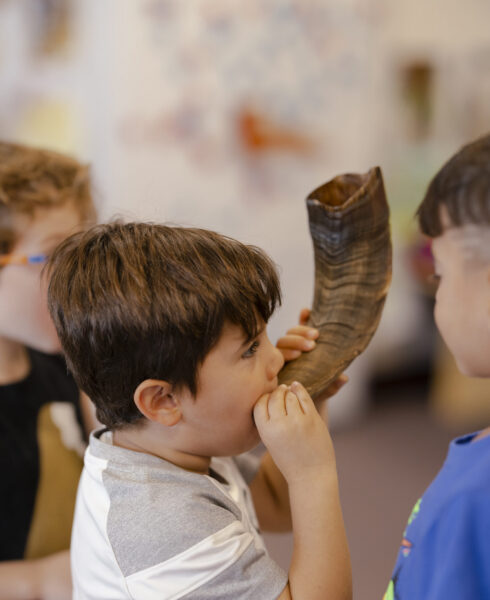

There’s a particular kind of learning that happens when you build a sukkah with your own hands, when you hear the shofar’s call echo down a hallway, when the whole school spins into dance on Simchat Torah. It’s learning you feel in your body before you can explain it in words. Jewish holidays offer exactly this — and in a Jewish day school, they become one of the richest classrooms a child will ever know.
At Schechter, the holidays aren’t interruptions to the academic calendar. They are the calendar. The Jewish year, with its cycle of festivals and seasons, shapes how time itself is taught and felt. Here’s the role those holidays play in a child’s education.
The Calendar Becomes a Curriculum
A Jewish day school doesn’t bolt the holidays onto the school year — it organizes the year around them. The arc from Rosh Hashanah through the High Holy Days, into Sukkot, Hanukkah, Purim, Passover, and Shavuot gives students a living framework for time. Each festival carries its own themes, stories, and questions.
This rhythm teaches something a textbook can’t: that time has meaning and shape. Students learn to anticipate, prepare for, and reflect on each season. The repeating cycle, year after year, lays down a deep structure that stays with a child for life — so that as adults, the turning of the Jewish year feels as natural as the seasons themselves.
Holidays Make Abstract Ideas Tangible
Big ideas are hard to teach in the abstract. Holidays make them concrete. Freedom isn’t a vocabulary word at the Passover seder — it’s a story acted out, tasted, and discussed. Gratitude takes physical form in the fragile walls of a sukkah. Reflection and renewal become real in the introspection of the High Holy Days.
This is experiential learning at its best. When a child encounters a value through ritual, food, song, and story, it lodges in memory far more firmly than a lecture ever could. The holidays turn Jewish concepts into experiences a child can hold onto — and the lessons travel with them.
Joy at the Heart of Learning
Jewish tradition treats celebration as essential, not incidental — simcha is a value in its own right. The holidays are where that joy shines brightest, and a Jewish day school leans into it fully: the music, the costumes of Purim, the festive meals, the singing and dancing that turn a school day into something memorable.
That joy does serious educational work. Children who associate their tradition with delight build a warm, lasting bond with Jewish life. The festivity isn’t a break from learning; it’s part of how the deepest learning happens. A holiday celebrated with genuine simcha becomes a memory a child carries for decades.
Celebrating Together Builds Community
Holidays are rarely solitary. They gather people — and in a school, they gather the whole kehillah. All-school celebrations, holiday programs that welcome families, and shared rituals knit students, teachers, and parents into a single community moving through the year together.
These shared moments are where belonging is built. A child who has stood with their whole school to welcome a holiday, who has celebrated alongside classmates and seen their own family woven into the event, learns that they are part of something larger. The holidays become the heartbeat of community life — the recurring occasions when kehillah is felt most strongly.
Connecting Students to the Jewish People
Finally, the holidays link a child to Jews everywhere and across time. When students light Hanukkah candles or sit down to a seder, they’re doing what Jewish families have done for generations and what Jewish communities around the world are doing in the very same season. Many holidays also deepen a connection to Yisrael, the land and people of Israel, whose seasons and story are woven through the festivals.
This is how a child comes to feel part of Yisrael — the Jewish people stretched across history and geography. The holidays make that vast connection vivid and personal, turning an abstract sense of peoplehood into something a child has actually lived.
The Bottom Line
Jewish holidays are among the most powerful teaching tools a day school has. At Schechter, they:
- Structure the year — giving students a living framework for time and meaning.
- Make ideas tangible — turning values like freedom and gratitude into lived experience.
- Center joy — using simcha to build a lasting, warm bond with Jewish life.
- Build community — gathering the whole kehillah of students and families.
- Connect to peoplehood — linking children to Jews across the world and through history.
The holidays teach what no worksheet can: that Jewish life is something you live, celebrate, and belong to. For a child, that may be the most important lesson of all.